
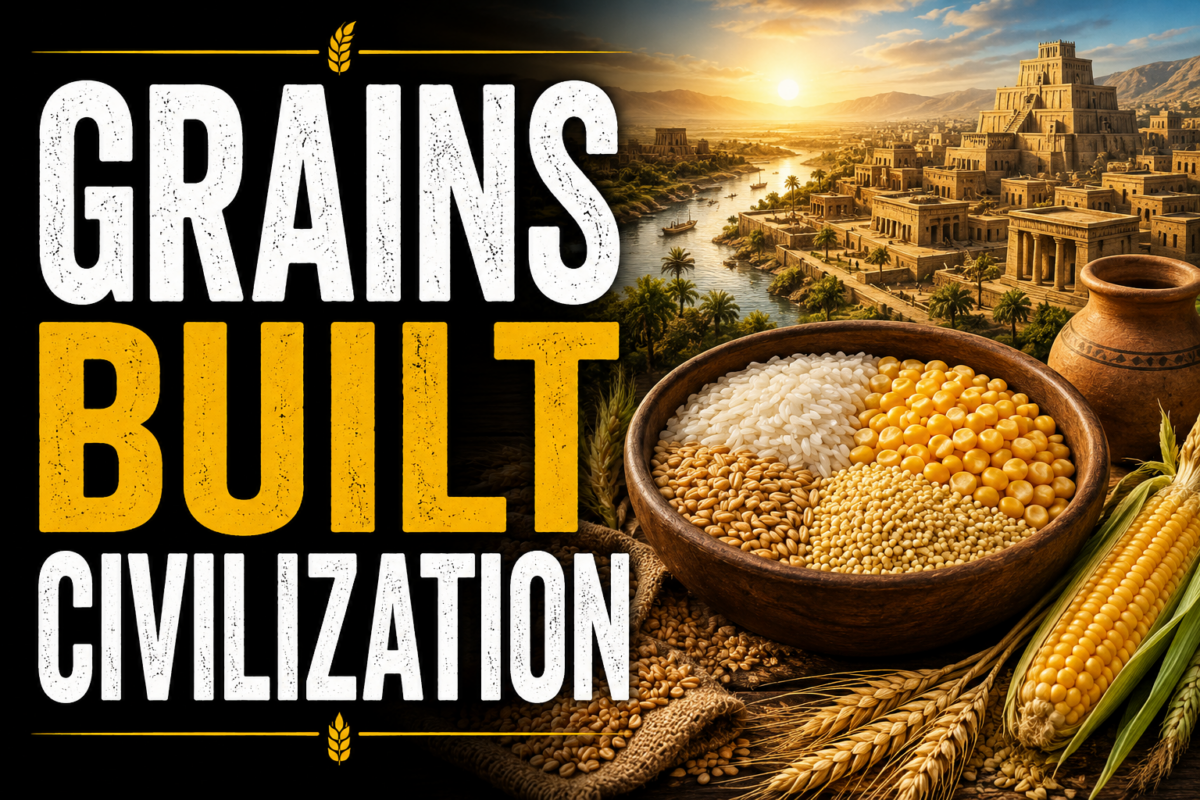
Why did grains build civilizations?
Because they provided a stable, dependable food supply that allowed human communities to grow, settle, and thrive.
Rice, wheat, corn, and millet were never just foods.
They were the foundation of survival.
Without staple grains, there would have been no cities, no empires, and no lasting agricultural societies.
Why Grains Built Civilizations
Hunter-gatherers could survive in small groups, but large societies required consistent nourishment.
Grains offered several advantages:
- they produced large harvests
- they could be dried and stored
- they were transported easily
- they fed large populations year-round
This stability allowed people to settle permanently, cultivate land, and develop complex cultures.
Staple Foods as the Basis of Human Life
Across the world, staple foods became central to daily existence.
- Rice nourished much of Asia.
- Wheat sustained the Middle East and Europe.
- Corn supported the civilizations of the Americas.
- Millet fed many regions of Africa and northern China.
These grains were not optional foods.
They were the foundation of security and survival.
Grain in Language and Wisdom
Traditional sayings reflect the deep respect people held for staple foods:
- “Rice is life.”
- “Corn is the mother of sustenance.”
- “Take care of the grain, and the grain will take care of you.”
- “A field of wheat feeds more than a field of gold.”
These expressions were born from experience.
People understood that grain meant life.
More Than Food
Grains represented:
- survival
- stability
- prosperity
- cultural identity
- continuity across generations
A successful harvest brought peace and abundance.
A failed harvest brought hardship and famine.
This is why grains were often honored in ceremonies and traditions.
Closing Thought
Why grains built civilizations is not a mystery.
They provided the dependable nourishment that made organized human life possible.
Before grains were labeled carbohydrates, they were recognized as the foods that kept humanity alive.
And that historical truth still deserves our respect.
Next in the Series:
How Diet Culture Turned Food Into Numbers—and Why We Fear Carbs