
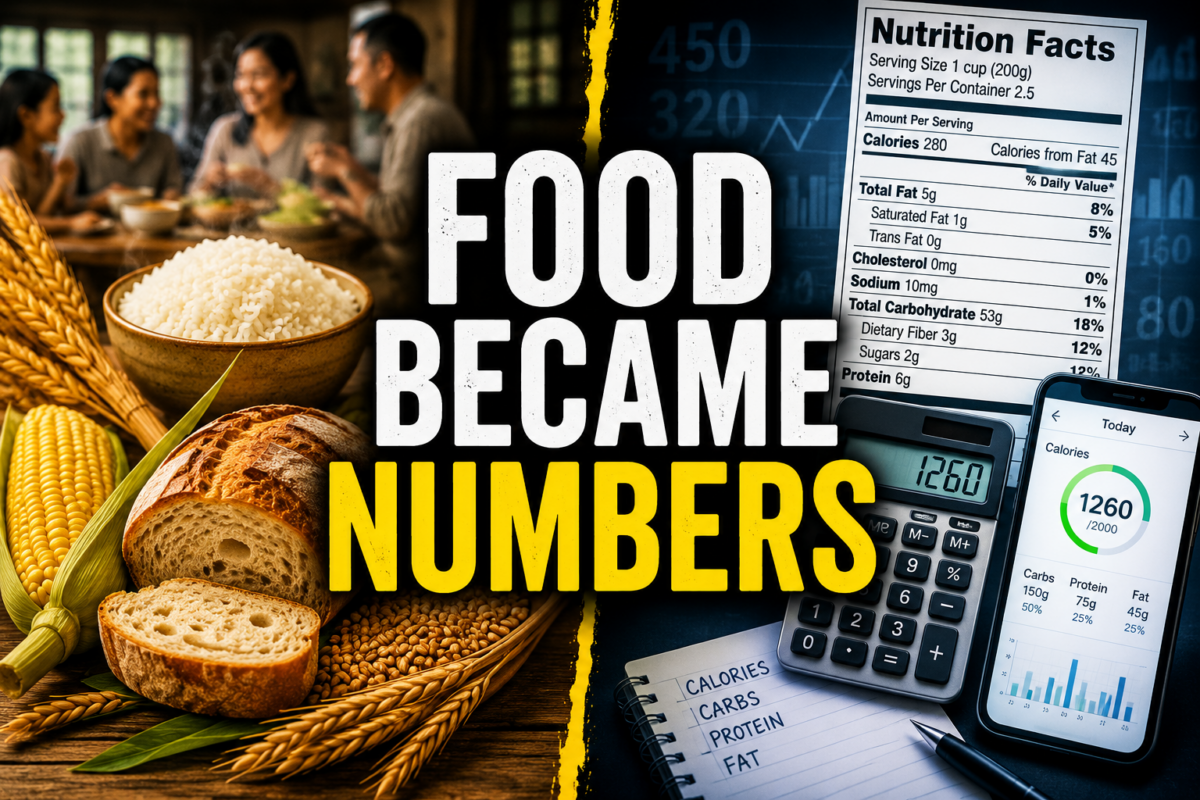
Modern nutrition has given us valuable tools to understand health.
But it has also encouraged us to think about food in increasingly numerical terms.
Calories. Macros. Carb counts. Glycemic scores.
These measurements can be useful.
Yet when numbers become the primary way we view food, something essential can be lost.
How Diet Culture Turned Food Into Numbers
Diet culture teaches people to evaluate food by metrics such as:
- calories
- carbohydrate grams
- fat percentages
- protein targets
Foods are labeled as “good” or “bad,” “clean” or “cheating.”
Instead of asking whether food supports life and health, people often ask whether it fits a numerical goal.
Why We Fear Carbs
Staple foods like rice, bread, and corn are increasingly viewed as “high-carb foods.”
For many people, this label creates anxiety.
Foods that nourished civilizations are treated as dietary problems to control or avoid.
The food itself has not changed.
What has changed is the framework used to interpret it.
Numbers Are Useful but Incomplete
A bowl of rice can be described by:
- carbohydrate grams
- calories
- fiber content
But numbers do not describe:
- its role in history
- its cultural meaning
- its contribution to human survival
- its ability to support active life
Measurement is valuable, but measurement is not the whole story.
Closing Thought
How diet culture turned food into numbers reveals both the strength and the limitation of modern nutrition.
Numbers can help us analyze food.
But they should not replace our understanding of food as a foundation of life.
When we fear carbs, we may forget the larger role these foods have played in human health and civilization.
Next in the Series:
Food Is More Than Nutrition: Why We Eat for Energy, Health, and Active Life
One thought on “How Diet Culture Turned Food Into Numbers—and Why We Fear Carbs”