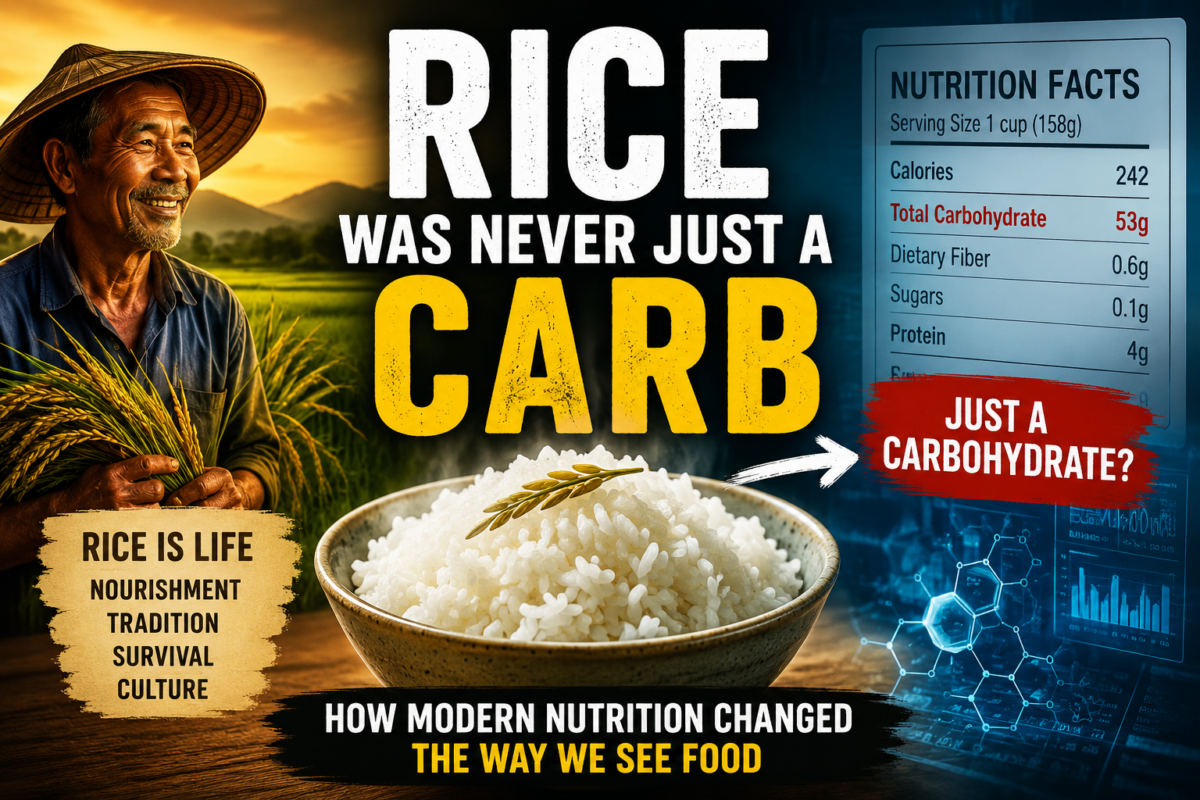
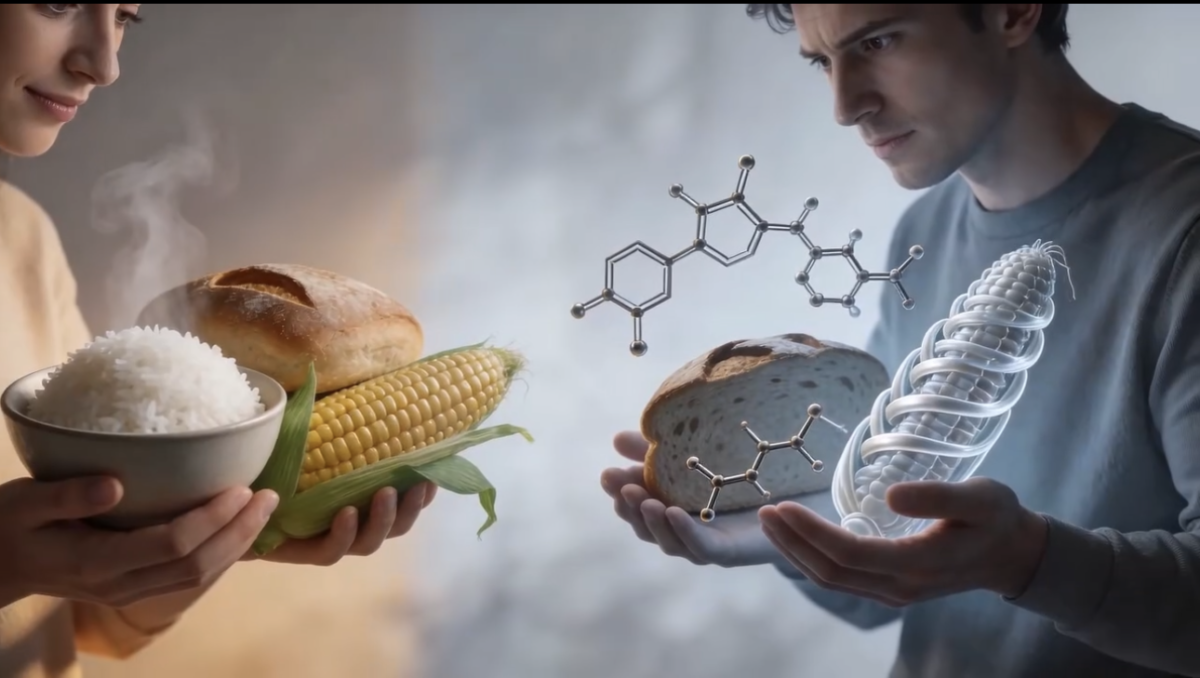
From Staple Foods to Carbs: How Modern Nutrition Changed the Way We See Grains

For most of human history, people did not talk about carbohydrates.

They talked about rice, wheat, corn, millet, barley, and oats.

More importantly, they did not think of these foods as nutrient categories. They thought of them as the foundation of life.

These staple foods fed families, sustained civilizations, and supported the energy required for work, growth, and survival.

Somewhere along the way, that changed.

Today, many of the same foods that nourished humanity for thousands of years are commonly grouped under a single scientific label: carbohydrates.

This classification is scientifically accurate.

But when staple foods became “carbs,” the way we understood food began to shift.

The real question is not whether carbohydrates exist.

The real question is what we lose when chemistry becomes the primary lens through which we view food.

From Staple Foods to Carbs

The journey from staple foods to carbs reflects one of the most significant changes in modern thinking about nutrition.

In traditional cultures, food was understood through direct experience.

People knew which foods sustained strength, supported labor, and helped families survive through the seasons.

Rice was not simply starch.

Wheat was not just glucose chains.

Corn was not merely a source of calories.

These foods were the dependable foundations upon which societies were built.

Modern nutrition introduced a new vocabulary:

  • carbohydrates
  • proteins
  • fats
  • calories
  • vitamins
  • minerals

This language has greatly improved our ability to study metabolism and disease.

But it also encouraged us to view food as a collection of measurable parts.

As a result, staple foods gradually shifted from being recognized as life-sustaining foundations to being discussed as macronutrient categories.

Part 1: When Rice Became a Carb

For thousands of years, rice was understood as one of humanity’s most important foods.

Across Asia and many other parts of the world, rice symbolized nourishment, stability, and abundance.

Traditional sayings expressed this clearly:

  • “Rice is life.”
  • “Where there is rice, there is hope.”

These phrases were not metaphors.

They reflected the reality that rice sustained billions of people.

When rice became a carb, our language changed.

And when language changes, perception changes.

A bowl of rice that once represented family, labor, and survival could suddenly be reduced to a number on a nutrition label.

Part 2: What Are Carbohydrates, Really?

In scientific terms, carbohydrates are sugars, starches, and fiber.

They are one of the body’s major sources of fuel.

This definition is accurate and useful.

But it answers only one question:

What is food made of?

It does not answer another, equally important question:

What is food for?

A bowl of rice is chemically composed of carbohydrates.

But its role in human life is far greater.

It is a staple food that has supported physical work, growth, healing, and civilization for thousands of years.

Understanding food solely by composition can obscure its larger purpose.

Part 3: Why Grains Built Civilizations

Human civilization became possible only when stable food supplies were established.

Grains such as rice, wheat, corn, and millet provided that stability.

They could be:

  • cultivated efficiently
  • harvested in large quantities
  • stored for long periods
  • used to feed growing populations

Because of these qualities, grains became the foundation of settled communities and complex societies.

Across cultures, grain was treated with deep respect because people understood that it meant life.

A successful harvest brought security.

A failed harvest brought famine.

This historical reality explains why staple foods occupy such a central place in language, tradition, and ritual.

Part 4: How Diet Culture Turned Food Into Numbers

Modern nutrition science has provided powerful analytical tools.

But modern diet culture has often taken those tools and reduced food to numerical targets:

  • calories
  • macros
  • carbohydrate grams
  • glycemic scores

In this framework, food is frequently judged by whether it fits a plan rather than by how it supports health and active life.

Staple foods are often labeled:

  • “high-carb”
  • “foods to limit”
  • “dietary variables”

The food itself has not changed.

What has changed is the way we think about it.

Part 5: Food Is More Than Nutrition

Food is more than nutrients.

It is the foundation of energy, health, and active life.

Modern nutrition tells us what food contains.

Traditional wisdom reminds us why food matters.

We do not eat merely to satisfy chemical requirements.

We eat to:

  • move
  • work
  • think
  • heal
  • reproduce
  • live fully

The ultimate value of food lies not only in its composition, but in its ability to support human vitality.

This is the central principle of the Total Life Energy Plan:

Health Is Life Energy in Abundance.

What Language Reveals—and What It Hides

Words influence what we notice.

When we say “rice,” we may think of:

  • family meals
  • agricultural traditions
  • cultural identity
  • nourishment
  • survival

When we say “carbs,” we often think of:

  • restrictions
  • blood sugar
  • weight gain
  • diet rules

Both descriptions are technically correct.

But they lead us to focus on very different aspects of the same food.

Language can illuminate.

It can also narrow our perspective.

The Limitation of Nutritional Reductionism

Reductionism is a powerful scientific method.

By studying individual components, science has helped us understand many aspects of human health.

But analyzing parts is not the same as understanding the whole.

A violin can be described as wood and strings.

That description is accurate, but it does not explain music.

Likewise, rice can be described as carbohydrate.

But that description does not explain its role in sustaining civilizations.

Food must be understood both scientifically and holistically.

Rice Is Not Just a Carbohydrate

Rice is chemically classified as a carbohydrate.

But rice is also:

  • a staple food
  • a cultural symbol
  • a source of strength
  • a historical foundation
  • a daily expression of life

The same is true for wheat, corn, millet, and other grains.

Before they were categorized as nutrients, they were the foods that kept humanity alive and healthy.

A Return to Balance

The goal is not to reject science.

Science provides valuable tools for understanding the body and improving health.

But scientific language should complement—not replace—our broader understanding of food.

To understand food fully, we must see it as:

  • chemistry
  • history
  • survival
  • culture
  • medicine
  • life energy

At the same time.

Closing Thought

Perhaps the most important question is not:

Why did we start calling staple foods carbohydrates?

Perhaps the more important question is:

What do we stop seeing when we only measure food in numbers?

Rice is not just a carbohydrate.

Wheat is not just starch.

Corn is not just calories.

Before they were nutrients, they were what sustained generations of human life.

And that truth still matters.

Related Articles in This Series

  1. When Rice Became a Carb: How Modern Nutrition Changed the Way We Talk About Food
  2. What Are Carbohydrates, Really? Why Nutrition Science Doesn’t Tell the Whole Story
  3. Why Grains Built Civilizations: The Hidden Importance of Staple Foods
  4. How Diet Culture Turned Food Into Numbers—and Why We Fear Carbs
  5. Food Is More Than Nutrition: Why We Eat for Energy, Health, and Active Life

Total Life Energy Plan
Lasting Health, Powered by Nature and Honored by History.
Health Is Life Energy in Abundance.
Food Is More Than Nutrition: Why We Eat for Energy, Health, and Active Life

Food is more than nutrition.

This simple truth may be one of the most important ideas in health.

Modern nutrition tells us what food is made of.

But food exists for a greater purpose: to support energy, health, and active human life.

Food Is More Than Nutrition

A meal is more than:

  • proteins
  • fats
  • carbohydrates
  • vitamins
  • minerals

Food also represents:

  • survival
  • strength
  • healing
  • cultural tradition
  • the capacity to live actively

Understanding food only through nutrients is like understanding music only through sound waves.

The parts matter, but they do not explain the whole.

Why We Eat for Active Life

Human beings do not eat merely to satisfy chemical requirements.

We eat to:

  • move
  • work
  • think
  • heal
  • reproduce
  • live fully

The true value of food is measured by the quality of life it supports.

Staple foods such as rice, wheat, corn, and millet have served this purpose for thousands of years.

Food as the Foundation of Health

Traditional cultures understood food as the basis of vitality.

In many healing traditions, food was regarded as the first medicine.

Its purpose was not simply to provide nutrients, but to sustain the body’s natural capacity for health.

This aligns with the Total Life Energy Plan philosophy:

Health Is Life Energy in Abundance.
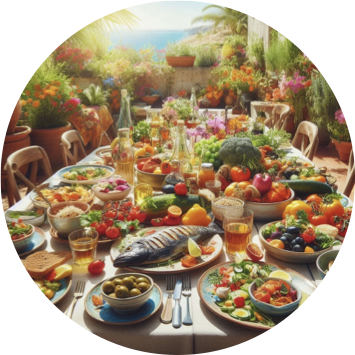
Closing Thought

Rice is not only a carbohydrate.

Wheat is not only starch.

Corn is not only a source of calories.

Before these foods were reduced to nutrient categories, they supported the energy, health, and active lives of countless generations.

Food is more than nutrition.

It is the foundation of life itself.

Continue to the Complete Guide:
From Staple Foods to Carbs: How Modern Nutrition Changed the Way We See Grains

How Diet Culture Turned Food Into Numbers—and Why We Fear Carbs

Modern nutrition has given us valuable tools to understand health.

But it has also encouraged us to think about food in increasingly numerical terms.

Calories. Macros. Carb counts. Glycemic scores.

These measurements can be useful.

Yet when numbers become the primary way we view food, something essential can be lost.

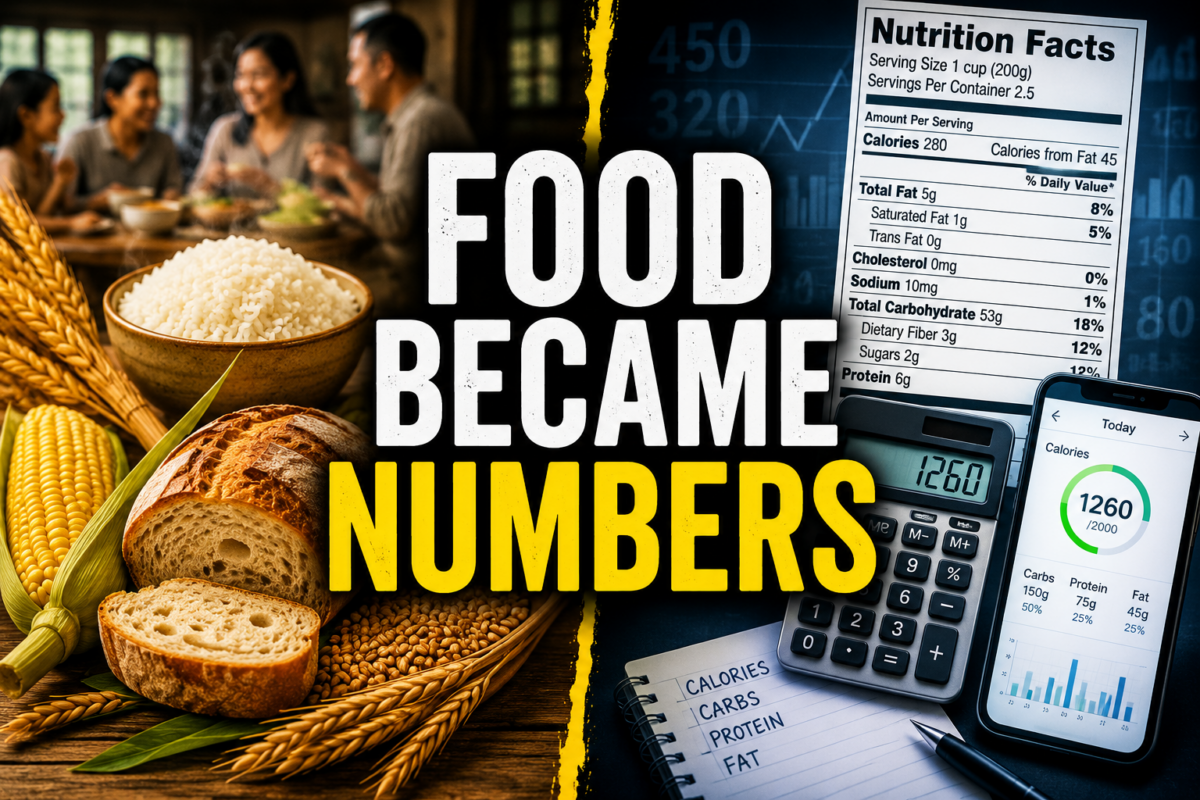
How Diet Culture Turned Food Into Numbers

Diet culture teaches people to evaluate food by metrics such as:

  • calories
  • carbohydrate grams
  • fat percentages
  • protein targets

Foods are labeled as “good” or “bad,” “clean” or “cheating.”

Instead of asking whether food supports life and health, people often ask whether it fits a numerical goal.

Why We Fear Carbs

Staple foods like rice, bread, and corn are increasingly viewed as “high-carb foods.”

For many people, this label creates anxiety.

Foods that nourished civilizations are treated as dietary problems to control or avoid.

The food itself has not changed.

What has changed is the framework used to interpret it.

Numbers Are Useful but Incomplete

A bowl of rice can be described by:

  • carbohydrate grams
  • calories
  • fiber content

But numbers do not describe:

  • its role in history
  • its cultural meaning
  • its contribution to human survival
  • its ability to support active life

Measurement is valuable, but measurement is not the whole story.

Closing Thought

How diet culture turned food into numbers reveals both the strength and the limitation of modern nutrition.

Numbers can help us analyze food.

But they should not replace our understanding of food as a foundation of life.

When we fear carbs, we may forget the larger role these foods have played in human health and civilization.

Next in the Series:
Food Is More Than Nutrition: Why We Eat for Energy, Health, and Active Life

What Are Carbohydrates, Really? Why Nutrition Science Doesn’t Tell the Whole Story

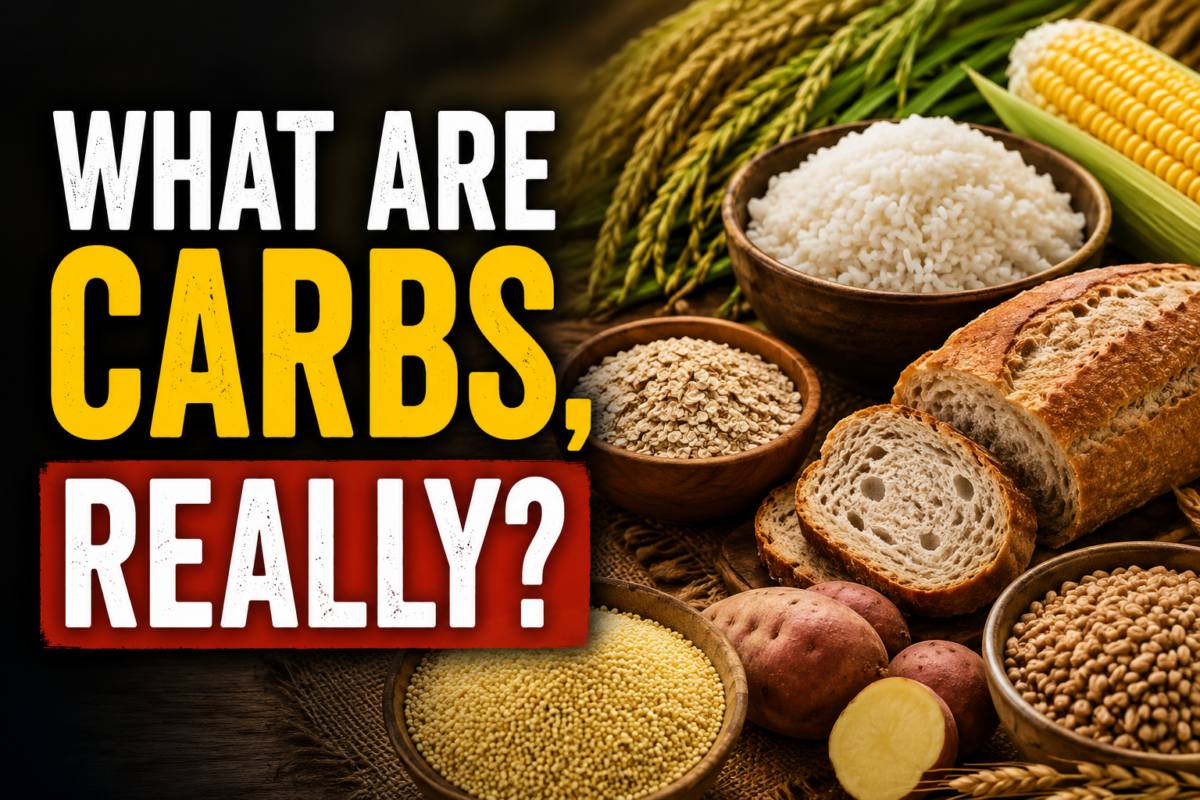
What are carbohydrates, really?

In modern nutrition, carbohydrates are defined as sugars, starches, and fiber—one of the three major macronutrients that provide energy to the body.

This scientific classification is useful.

It helps researchers study metabolism and helps clinicians understand how food affects health.

But the question “What are carbohydrates, really?” has more than one answer.

Chemically, carbohydrates are molecules.

In human life, they are often the very foods that sustained entire civilizations.

Rice, bread, corn, millet, and wheat are classified as carbohydrates.

But they are not merely chemical compounds.

They are staple foods that have nourished billions of people for thousands of years.

The Scientific Meaning of Carbohydrates

The word “carbohydrate” belongs to chemistry.

It describes compounds made of carbon, hydrogen, and oxygen that the body can use as a major source of fuel.

From this perspective, rice is primarily starch.

Bread is composed largely of carbohydrates.

Corn contains sugars, starches, and fiber.

This way of describing food is scientifically accurate and valuable in research.

But it tells us only what food is made of.

It does not tell us what food means, how it functions in real human life, or whether a particular way of eating will truly support long-term health.

The Difference Between Composition and Meaning

Knowing the ingredients of something is not the same as understanding its purpose.

A violin can be described as wood, strings, and glue.

But that description does not explain music.

In the same way, rice can be described as carbohydrate.

But that description does not explain why rice became one of the most important foods in human history.

Science reveals structure.

Life reveals function.

Both are useful, but they answer different questions.

Why Nutrition Science Doesn’t Tell the Whole Story

Nutrition science helps us understand the parts of food.

Traditional food culture helps us understand the whole.

A bowl of rice is more than:

  • starch
  • fiber
  • calories
  • molecular bonds

It is also:

  • the result of farming and labor
  • a daily meal shared by families
  • a source of strength for physical work
  • a symbol of survival and abundance

When we focus only on chemical composition, we may miss the broader significance of food in human life.

When Scientifically Correct Advice Becomes Incomplete

This is not about rejecting science.

Science has given us many valuable insights into food and health.

But scientific descriptions are not the same as complete guidance for living.

Modern nutrition often provides scientifically correct explanations.

Yet when those explanations become the primary basis for deciding what people should eat, they can overlook how food affects the whole person.

A food may be accurately described in the laboratory while still being misunderstood in daily life.

This is one reason why some widely accepted dietary recommendations may sound logical and scientific, yet fail to support lasting health.

The problem is not science itself.

The problem arises when chemistry is treated as the full story of food.

Food Was Understood Long Before Nutrition Labels

People relied on grains for thousands of years before anyone discovered the term “carbohydrate.”

They knew from direct experience that these foods supported energy, work, reproduction, healing, and survival.

They did not need laboratory terminology to understand that rice and wheat were essential.

Their knowledge was practical, time-tested, and refined across generations.

Closing Thought

So what are carbohydrates, really?

From the perspective of chemistry, they are molecules that provide fuel.

From the perspective of human history, they are staple foods that sustained civilizations.

Both descriptions are true.

But chemistry alone does not tell the whole story.

To understand food fully, we must see both its structure and its role in supporting energy, health, and active human life.

Next in the Series:
Why Grains Built Civilizations: The Hidden Importance of Staple Foods

When Rice Became a Carb: How Modern Nutrition Changed the Way We Talk About Food

We rarely notice when language changes the way we think.

But sometimes, a single word can quietly transform our understanding of something as fundamental as food.

For most of human history, people did not eat “carbohydrates.”

They ate rice, wheat, corn, millet, and barley—foods that nourished families, sustained civilizations, and formed the foundation of daily life.

These staple foods were not viewed as nutrient categories. They were seen as life itself.

Somewhere along the way, that changed.

Today, rice is often described as “a carb.” Bread is labeled “high-carb.” Corn is discussed as a source of starch and calories.

Scientifically, this is correct.

But when rice became a carb, the way we talked about food—and the way we understood it—began to shift.

Before Rice Became a Carb

For thousands of years, staple foods carried meaning far beyond their physical composition.

Across cultures, people expressed this truth in simple sayings:

  • “Rice is life.”
  • “Corn is the mother of sustenance.”
  • “Take care of the grain, and the grain will take care of you.”
  • “A field of wheat feeds more than a field of gold.”

These were not scientific statements.

They were expressions of lived experience.

A good harvest meant security. A failed harvest meant famine.

Grains were not dietary options. They were the foundation of survival, stability, and civilization.

No one needed the word “carbohydrates” to understand their value.

How Modern Nutrition Changed the Way We Talk About Food

Modern nutrition introduced a new vocabulary:

  • carbohydrates
  • proteins
  • fats
  • calories
  • macronutrients

This language has many practical uses.

It helps researchers study metabolism and helps clinicians understand disease.

But scientific language was designed to analyze food, not to replace our entire relationship with it.

When rice became a carb, food began to be viewed primarily through its chemical components rather than its role in human life.

Rice became starch.

Bread became glucose.

Corn became an energy source.

The food remained the same, but our perception changed.

Language Shapes What We See

Words do more than describe reality.

They shape what we notice and what we overlook.

When we say “rice,” we may think of:

  • family meals
  • farming traditions
  • cultural identity
  • nourishment
  • survival

When we say “carbs,” we often think of:

  • numbers
  • restrictions
  • diet rules
  • blood sugar
  • weight gain

Both descriptions are technically valid.

But they lead us to see the same food in very different ways.

When Food Becomes a Number

In modern diet culture, carbohydrates are often treated as something to limit, count, or avoid.

As a result, many people no longer see rice as one of humanity’s most important staple foods.

Instead, they see it as a nutritional variable.

This shift may seem small, but it changes our relationship with food.

A bowl of rice is no longer viewed as the foundation of life for billions of people.

It becomes a number on a diet plan.

Why This Matters

This is not a rejection of science.

Scientific understanding has provided valuable insights into human health.

But food is more than chemistry.

Food is also history, labor, memory, and culture.

When rice became a carb, we gained scientific precision.

But we risked losing something equally important: context.

Closing Thought

Rice is chemically a carbohydrate.

But it is also much more than that.

For thousands of years, rice fed civilizations, sustained families, and supported active human life.

Before it was a nutrient category, it was the foundation of survival.

And that truth still matters.

Next in the Series:
What Are Carbohydrates, Really? Why Nutrition Science Doesn’t Tell the Whole Story

Is Modern Nutrition Misleading?

In today’s world, nearly everyone believes in the concept of “nutrition” — calories, vitamins, minerals, and macronutrients carefully calculated and tracked. But is modern nutrition truly the path to better health and vitality? Or is it misleading us away from the real sources of nourishment?

The Birth of Modern Nutrition

Modern nutrition, as we know it, began with reductionist science: breaking down food into isolated components like carbohydrates, protein, and fat. Later, vitamins and minerals were added to the list, along with fiber and antioxidants. While this approach helped cure extreme deficiencies like scurvy or rickets, it created a false sense of understanding that still misleads people today.

Modern nutrition assumes that human health can be engineered by counting molecules and supplementing what’s missing. But real human vitality is far more complex — and deeply rooted in life energy, not just lab measurements.

The Problem with Nutrient Numbers

Have you ever eaten a “balanced” meal and still felt tired, cold, bloated, or mentally foggy? That’s because your body isn’t just a machine that runs on nutritional data. It’s a living, breathing energy system.

According to traditional medicine, especially systems like Traditional Chinese Medicine (TCM), food is classified by its energetic effects on the body — warming, cooling, drying, moistening, strengthening, or weakening. For example:

  • Spinach may be rich in iron, but its cold nature can weaken digestion in someone with low yang energy.
  • Raw juice might deliver “vitamin C,” but it can also deplete the stomach’s fire and lead to bloating and fatigue.

No amount of isolated nutrients can replace the wisdom of choosing food based on how it supports your whole energy system.

Supplements: A False Solution?

When studies show a certain diet is “lacking,” modern nutrition recommends supplements: vitamin B12, iron pills, protein powders. But do synthetic or extracted nutrients really nourish the body the same way as whole, energetically rich foods?

Most supplements are poorly absorbed, and many tax the liver and kidneys. Some may temporarily improve blood test numbers, but do they restore life force, warmth, and vitality?

True nourishment happens when food supports the body’s energy and organ systems, not when we try to patch deficiencies with pills.

👉 Want to learn more? Read my post: Do You Believe in Nutrition?

How the Body Really Absorbs Nourishment

Real healing comes from food that aligns with your body’s energy needs. In traditional medicine, the digestive system — especially the Spleen and Stomach — needs warmth, stability, and rhythmic support. Food that is too raw, cold, or processed can damage your digestion, even if it’s labeled “nutrient-dense.”

Life energy comes first. Without a strong energy system, the body cannot extract or utilize even the most perfect blend of vitamins and minerals. This is why people with weak digestion often suffer from fatigue, poor immunity, or nutrient deficiencies — no matter how clean or “healthy” their diet appears.

Are We Nourishing the Numbers or the Person?

Modern nutrition misleads by reducing food to math and molecules. But true nourishment is about supporting your whole self: body, mind, and spirit.

Ask yourself:

  • Am I choosing food based on numbers or how it makes me feel?
  • Is this food strengthening or draining my energy?
  • Am I following expert advice, or tuning in to my own healing response?

Your body is not a spreadsheet. It’s a self-healing miracle — when you give it the right kind of support.

What to Do Instead

  • Choose foods that are energetically warming, especially if you’re cold, tired, or living in a cold climate.
  • Avoid over-relying on raw, juiced, or overly processed foods—even if they’re trendy.
  • Use herbs and warming spices like ginger, cinnamon, and garlic to support digestion.
  • Stop treating your meals like chemistry experiments and start honoring them as rituals of healing and replenishment.

In Conclusion: Is Modern Nutrition Misleading?

Yes, it can be — when it leads us away from our body’s intuitive wisdom, when it ignores the energetic nature of food, and when it promises health through numbers instead of nourishment.

Let go of the formulas and fads. Reconnect with real nourishment — not just for the body, but for your whole life energy. Check out the Total Life Energy Plan and eat for life!

Do Weight Loss Programs Work?

The Real Reason They Fail—and How to Break Free

“Lose 10 pounds in 10 days!”
“Drop a dress size before the weekend!”
The promises are everywhere. But do weight loss programs actually work?

Millions have tried calorie-counting apps, meal replacement shakes, trendy diets, and now even weight loss drugs—only to see the pounds return… and often bring friends. More alarming? Many people who follow these programs experience worse health in the long run, even if they lose weight at first.

Let’s uncover why.


The Trap of Modern Weight Loss Programs

Most weight loss programs are built on a single idea: reduce intake and increase output.
But this surface-level equation completely ignores how your body’s energy system actually works.

From the Total Life Energy perspective, weight gain or loss isn’t just about what you eat or how much you exercise—it’s about your body’s internal balance and ability to digest, absorb, and utilize nourishment.

When your energy system is out of balance, your body can’t function properly. Digestion becomes sluggish. Food doesn’t transform into usable energy. It gets stuck. Fluids get retained. Waste builds up. That’s what creates real, stubborn weight.


Why Extreme Weight Loss Is Dangerous

Many modern diet foods, pills, and even herbal supplements are harsh on the digestive system. They force weight loss by damaging your body’s ability to absorb food. When your digestion is weak, your body can’t hold onto nourishment—even the healthy food you eat may pass right through without being absorbed.

That’s why the initial pounds come off so quickly—not because you’re “burning fat,” but because your body is literally being emptied out. The more extreme the weight loss, the more damage done to your internal system.

This explains why some people with extreme weight loss end up suffering from fatigue, dizziness, diarrhea, and severe nutrient deficiency. In the worst cases, the body loses the ability to digest even rice, the most basic nourishing food in Traditional Chinese Medicine.


A Trend-Chasing Industry That Doesn’t Heal

Many people now chase weight loss drugs like Ozempic or Wegovy, desperate for a quick fix. But even Weight Watchers—once a giant in the diet industry—has filed for bankruptcy, as people jump from one trend to the next.

These programs may help you lose a few pounds temporarily, but they don’t help your body heal. When your internal system isn’t functioning well, the weight always comes back.

If your body doesn’t have the strength to detox, transform, and circulate nourishment, it can’t maintain a healthy weight.


Why Your Body Holds Onto Weight

From the Total Life Energy perspective, your body doesn’t gain excess weight for no reason. It’s a sign of imbalance. When the body loses the ability to break down and use food, processed food and fluids become stuck inside. That’s what creates bloating, puffiness, and fat accumulation—not a lack of willpower or a slow metabolism.

Fat isn’t always the enemy. When your body is functioning well, it knows how to store and use fat appropriately for protection and energy. But when the digestive and circulatory systems weaken, everything gets backed up. Your body gets heavier, not stronger.


Is Being Underweight Any Better?

Surprisingly, no.
Extreme weight loss can also signal severe digestive damage. When your system can’t absorb nutrients, it doesn’t matter how much you eat—your body can’t build blood, muscle, or energy. The result? Rapid weight loss, fatigue, hormonal imbalances, and a body too weak to fight illness.


So, Do Weight Loss Programs Work?

They might change the number on your scale—for a while.
But if they leave your digestion weaker, your energy depleted, and your body unbalanced, they don’t truly work.

Most programs focus on short-term results and visible changes, not internal healing. They ignore the deeper cause of weight imbalance: a weakened life energy system.


What Actually Works: The Total Life Energy Plan

Weight issues—whether overweight or underweight—are not just appearance problems. They are symptoms of internal dysfunction.

The Total Life Energy Plan looks at your whole body system to discover what’s causing your imbalance:

  • Is it your digestion?
  • Your kidneys or liver?
  • Your emotional energy?
  • Your overall yang or vitality?

This unique approach helps you understand what part of your body’s energy system is weak—so you can heal the root cause and naturally reach your healthy weight without dieting, pills, or punishing exercise.

Once your body is balanced, digestion strengthens, energy flows, and the weight normalizes itself—not through force, but through restoration.


Final Thoughts

Stop asking “how can I lose weight fast?” and start asking:
What does my body need to heal and restore balance?

Because when your internal energy is strong, your weight takes care of itself.
No more yo-yo diets. No more supplements. No more self-blame.
Just lasting health—powered by nature and honored by history.

Ready to take control of your health naturally—right from home?

Join my workshop at the Assabet Community Education Center in Marlborough, MA, and learn practical, sustainable strategies for managing your weight without commercial products. Empower yourself with tools you can use for life.

Natural Weight Control that Lasts

Next scheduled training starts March 24, 2026, every Tuesday at 6:00pm for 6 weeks.

The Weight Problem Paradox — Why Dieting Makes It Worse

Why Diets Fail—and Can Actually Make You Gain Weight

In a world flooded with weight-loss programs, meal plans, and fat-burning supplements, obesity continues to rise.
Why? Because most diets are built on flawed foundations that don’t support our body, its life, and long-term health.

Continue reading “The Weight Problem Paradox — Why Dieting Makes It Worse”

Eating by Nutrition Can Harm – How Your Nutritionist Makes You Nutrition Deficient

Eating by Nutrition Can Harm the Digestive System

The digestive system is the foundation of your health—responsible for breaking down food, extracting nutrients, and delivering energy to every part of the body. Yet many modern “healthy” diets, while praised for their nutritional content, unknowingly harm this vital system. In this blog post, we’ll concentrate on how Modern diet, including eating by nutrition, can harm the digestive system.

Let’s break it down:

  1. Emulsifiers in Processed Foods:
    Commonly found in sauces, dressings, and packaged items, emulsifiers can erode the gut lining and contribute to leaky gut syndrome.
  2. Sugar and Artificial Sweeteners:
    Excessive sugar—especially from artificial sources—stresses the spleen and pancreas, disrupts gut bacteria, and leads to bloating, fatigue, weight gain, and skin issues.
  3. Overly Nutrient-Dense Foods:
    Ironically, foods considered “super healthy” can overload and weaken the digestive system. When your digestive power is low, even highly nutritious foods become a burden rather than a benefit.
  4. Excessive Fiber Intake:
    Though fiber is often celebrated for gut health, too much can impair digestion—especially in people with weak or damaged digestive systems. High-fiber diets may cause indigestion, loose stools, constipation, and long-term digestive dysfunction.

Beyond food, stress—whether from a hectic lifestyle, emotional pressure, or rushed eating—further weakens the digestive system. It disrupts the gut-brain axis and can lead to conditions like IBS, ulcers, or chronic inflammation in organs like the stomach, spleen, and intestines. Skipping meals or eating on the go without proper chewing also compounds the problem.


How to Heal

True digestive healing starts with the right foods—and more importantly, the right philosophy. That means:

  • Avoiding foods that pressure and deplete your digestive energy (like high-fiber “health” foods and overly processed snacks).
  • Embracing warm, easy-to-digest, life-energy-rich meals made from fresh, natural ingredients.
  • Building long-term eating habits that restore and protect your digestive strength.

My book, Total Life Energy Plan, includes a dedicated chapter on how to rebuild your digestive function—step by step.

As you continue through this blog series or watch our videos, you’ll discover more about the often-ignored harms of eating by nutrition and how to reclaim a sustainable, energy-supporting way of eating.

Life Energy in Food: Why Modern Diets Leave You Feeling Drained


The Silent Energy Crisis in Modern Eating

You may be eating “clean”—organic, low-carb, even plant-based. But if you still feel tired, foggy, or emotionally flat, you’re not alone.

The problem? Most modern foods lack Life Energy—a vital force that sustains life, vitality, and resilience. Without it, food may fill your stomach but leave your body depleted.

Continue reading “Life Energy in Food: Why Modern Diets Leave You Feeling Drained”