
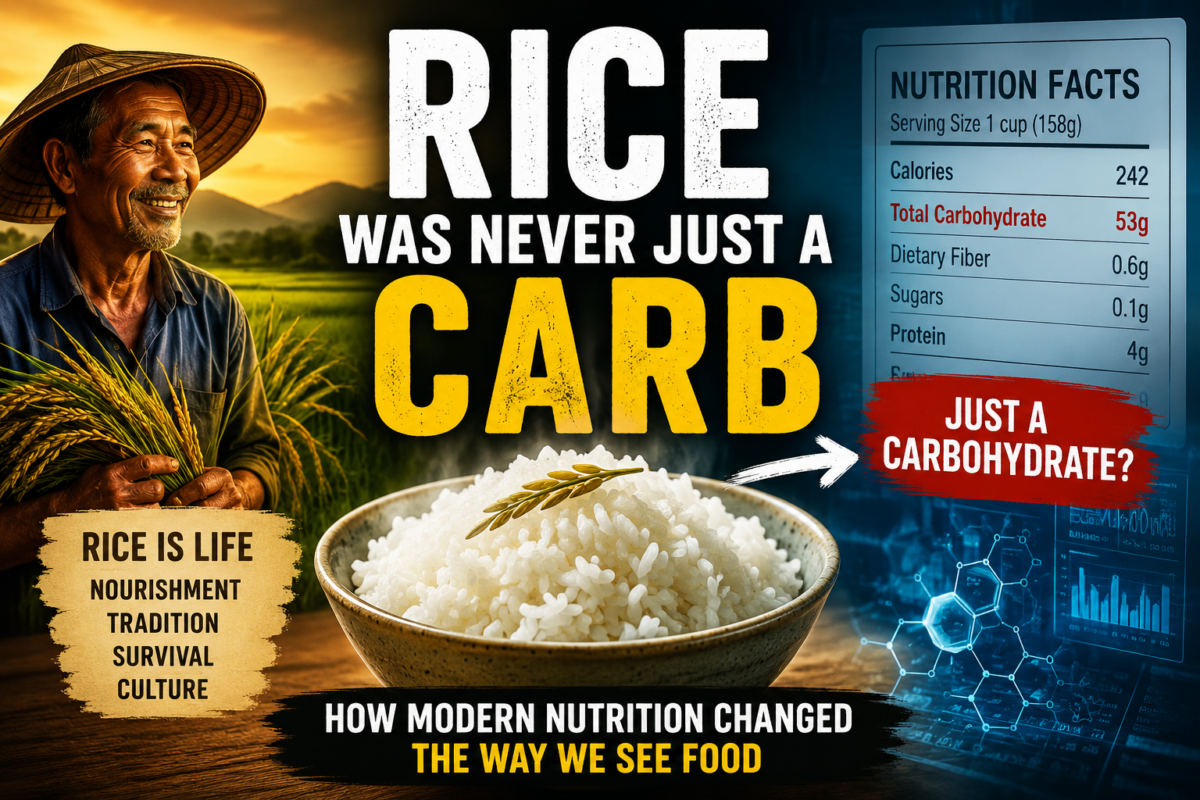
We rarely notice when language changes the way we think.
But sometimes, a single word can quietly transform our understanding of something as fundamental as food.
For most of human history, people did not eat “carbohydrates.”
They ate rice, wheat, corn, millet, and barley—foods that nourished families, sustained civilizations, and formed the foundation of daily life.
These staple foods were not viewed as nutrient categories. They were seen as life itself.
Somewhere along the way, that changed.
Today, rice is often described as “a carb.” Bread is labeled “high-carb.” Corn is discussed as a source of starch and calories.
Scientifically, this is correct.
But when rice became a carb, the way we talked about food—and the way we understood it—began to shift.
Before Rice Became a Carb
For thousands of years, staple foods carried meaning far beyond their physical composition.
Across cultures, people expressed this truth in simple sayings:
- “Rice is life.”
- “Corn is the mother of sustenance.”
- “Take care of the grain, and the grain will take care of you.”
- “A field of wheat feeds more than a field of gold.”
These were not scientific statements.
They were expressions of lived experience.
A good harvest meant security. A failed harvest meant famine.
Grains were not dietary options. They were the foundation of survival, stability, and civilization.
No one needed the word “carbohydrates” to understand their value.
How Modern Nutrition Changed the Way We Talk About Food
Modern nutrition introduced a new vocabulary:
- carbohydrates
- proteins
- fats
- calories
- macronutrients
This language has many practical uses.
It helps researchers study metabolism and helps clinicians understand disease.
But scientific language was designed to analyze food, not to replace our entire relationship with it.
When rice became a carb, food began to be viewed primarily through its chemical components rather than its role in human life.
Rice became starch.
Bread became glucose.
Corn became an energy source.
The food remained the same, but our perception changed.
Language Shapes What We See
Words do more than describe reality.
They shape what we notice and what we overlook.
When we say “rice,” we may think of:
- family meals
- farming traditions
- cultural identity
- nourishment
- survival
When we say “carbs,” we often think of:
- numbers
- restrictions
- diet rules
- blood sugar
- weight gain
Both descriptions are technically valid.
But they lead us to see the same food in very different ways.
When Food Becomes a Number
In modern diet culture, carbohydrates are often treated as something to limit, count, or avoid.
As a result, many people no longer see rice as one of humanity’s most important staple foods.
Instead, they see it as a nutritional variable.
This shift may seem small, but it changes our relationship with food.
A bowl of rice is no longer viewed as the foundation of life for billions of people.
It becomes a number on a diet plan.
Why This Matters
This is not a rejection of science.
Scientific understanding has provided valuable insights into human health.
But food is more than chemistry.
Food is also history, labor, memory, and culture.
When rice became a carb, we gained scientific precision.
But we risked losing something equally important: context.
Closing Thought
Rice is chemically a carbohydrate.
But it is also much more than that.
For thousands of years, rice fed civilizations, sustained families, and supported active human life.
Before it was a nutrient category, it was the foundation of survival.
And that truth still matters.
Next in the Series:
What Are Carbohydrates, Really? Why Nutrition Science Doesn’t Tell the Whole Story
One thought on “When Rice Became a Carb: How Modern Nutrition Changed the Way We Talk About Food”