Summer Heat: Why Hot Weather Makes You Feel Sick and How to Cool Down Naturally

Summer Heat: Why Hot Weather Makes You Feel Sick and How to Cool Down Naturally

Summer invites us outdoors.

The days are longer.

The sun is brighter.

Nature is full of life.

Yet for many people, the hottest weeks of summer don’t feel refreshing at all.

Instead, they bring overwhelming heat, constant thirst, headaches, heavy sweating, dizziness, fatigue, and a feeling that the body simply can’t cool down.

If you’ve ever wondered why summer heat seems to affect you more than everyone else, you’re not alone.

Many people experience summer heat as more than just an inconvenience. It can leave them physically drained, mentally exhausted, and unable to enjoy the season they once loved.

Modern life often encourages us to fight the heat with stronger air conditioning, ice-cold drinks, and constant rushing from one place to another.

Traditional seasonal wisdom offers a different perspective.

Rather than fighting nature, it teaches us to understand it.

According to Daoist health teachings, summer heat places extra demands on the body. As the body works continuously to cool itself, it gradually consumes fluids and life energy. When those reserves become depleted, many familiar summer symptoms begin to appear.

The encouraging news is that your body already has remarkable abilities to adapt to hot weather.

When you support those natural processes through seasonal living, appropriate foods, healthy daily habits, and adequate rest, the body becomes better equipped to stay balanced—even during the hottest days of the year.

In this article, you’ll discover why summer heat affects the body so strongly, how traditional wisdom explains these seasonal changes, and practical ways to stay cool while protecting your fluids, conserving your life energy, and enjoying a healthier summer.


Why Does Summer Heat Make You Feel Sick?

Summer heat places extra demands on the body’s natural ability to regulate temperature. According to traditional Daoist health teachings, prolonged heat gradually consumes body fluids and life energy as the body works harder to stay cool. Supporting your body through seasonal living, cooling foods, appropriate rest, and simple daily habits helps improve its ability to adapt naturally to hot weather.


Welcome Back to the Summer Care Series

Over the past three weeks, we’ve explored how summer influences emotional health, sleep, and excessive sweating.

This week, we focus on something that often lies behind many of those challenges:

Summer heat itself.

When temperatures rise, most people expect to feel warm.

But if you’ve ever found yourself feeling unusually thirsty, exhausted, dizzy, irritable, or unable to tolerate the heat, your body may be telling you that it is working much harder than normal to maintain balance.

One of the guiding principles of the Total Life Energy Plan reminds us:

The best evaluation is symptoms.

Instead of dismissing these experiences as “just part of summer,” we can begin asking a better question:

What is my body trying to tell me?

The body constantly communicates through symptoms.

Thirst.

Heavy sweating.

Headaches.

Fatigue.

Dizziness.

Each one provides valuable information about how well your body is adapting to the season.

Learning to recognize these signals early allows you to respond before simple discomfort develops into greater exhaustion.


Why Summer Heat Affects the Body So Strongly

Everyone experiences summer heat differently.

Some people seem comfortable even on the hottest days.

Others become exhausted after only a short time outdoors.

Traditional Daoist health teachings explain this difference by looking beyond the temperature itself and focusing on how the body responds to seasonal change.

During hot weather, the body works continuously to maintain a stable internal balance.

One of its primary cooling mechanisms is sweating.

As perspiration increases, the body gradually loses fluids.

At the same time, continually adapting to prolonged summer heat requires additional energy.

Over time, this combination may leave some people feeling:

  • Extremely thirsty
  • Dry
  • Tired
  • Weak
  • Dizzy
  • Irritable
  • Mentally fatigued
  • More sensitive to heat than usual

Traditional seasonal wisdom teaches that these symptoms are not random.

They are signs that the body is using significant resources to adapt to its environment.

The hotter the weather becomes, the harder the body must work to maintain balance.

Recognizing these early warning signs allows us to support the body’s natural cooling ability before exhaustion develops.


When Cooling Down Can Create New Problems

When people feel overheated, their first instinct is often to seek the coldest environment possible.

They leave intense sunshine and immediately enter freezing air-conditioned buildings.

They stand directly under powerful vents.

Cold air blows across the neck.

The shoulders.

The back.

The joints.

While air conditioning provides welcome relief, traditional seasonal living encourages moderation rather than extremes.

According to Daoist health teachings, moving repeatedly between intense outdoor heat and extremely cold indoor environments may disturb the body’s natural adjustment to the season.

Cold drafts striking the body immediately after heavy sweating are also traditionally associated with stiffness, muscle discomfort, and reduced comfort during summer.

This doesn’t mean you should avoid air conditioning.

Rather, it encourages using it wisely.

Choose comfortable cooling instead of extreme cold.

Allow the body to cool gradually.

Whenever possible, avoid directing strong cold airflow continuously onto your neck, shoulders, back, or joints.

Working with the body’s natural adaptation often provides more lasting comfort than constantly forcing it from one extreme to another.

Supporting Your Body During Summer Heat

The goal during summer heat is not to avoid warm weather altogether.

Summer is one of nature’s most vibrant seasons. It encourages movement, growth, and outdoor living.

The goal is to help the body adapt to summer heat naturally while conserving its fluids, protecting its life energy, and maintaining internal balance.

The Total Life Energy Plan teaches that lasting health is built through many small daily habits rather than one quick remedy.

For summer heat, those habits include staying aware of your body’s signals, avoiding extreme temperature changes, eating traditional cooling foods, taking time to rest during the hottest part of the day, and working with nature instead of against it.


A Traditional Pressure Point for Summer Heat

Traditional self-care includes several acupressure points that have long been used to support the body’s natural response to seasonal heat.

One of the best known is Large Intestine 11 (LI11), also called Pool at the Bend.

To locate the point, bend your elbow.

Look at the outer end of the elbow crease where a small hollow naturally forms.

Using your thumb, apply firm but comfortable pressure for about thirty seconds on each arm.

Traditionally, Large Intestine 11 has been used when addressing patterns associated with excess heat. Many practitioners also use it to help promote a greater sense of comfort during hot weather.

While this simple technique is not intended to treat illness, it can become a valuable part of a daily summer self-care routine whenever summer heat feels overwhelming.

Sometimes the body’s natural ability to restore balance simply needs gentle encouragement.


Cooling the Body from the Inside

One of the guiding principles of the Total Life Energy Plan reminds us:

Food is the best medicine.

The best pharmacy is the kitchen.

Traditional seasonal wisdom teaches that food should change with the seasons.

During periods of summer heat, the body naturally benefits from foods that help replenish fluids and gently support its cooling processes.

One of the most beloved traditional summer foods is watermelon.

For generations, watermelon has been enjoyed during hot weather because of its high water content and its traditional reputation for helping ease thirst and supporting the body’s natural cooling ability.

Another excellent summer food is cucumber, which has long been valued as a refreshing seasonal food during hot weather.

These cooling foods work best when they become part of an overall balanced seasonal diet.

As throughout the entire Summer Care Series, grains remain the foundation of the daily diet, providing steady nourishment in every season. Cooling foods such as watermelon and cucumber are intended to complement—not replace—that foundation.

Choosing fresh, seasonal meals that are simple and easy to digest allows the body to spend less energy on digestion and more energy adapting to the demands of summer.


Sometimes the Best Exercise Is Rest

When people feel overheated, many assume they simply need to push through it.

Traditional seasonal wisdom often recommends the opposite.

When the body is struggling with summer heat, adding more activity is not always the best answer.

Sometimes recovery begins with rest.

One of the simplest and most valuable summer practices is the Heart Nap.

Around the middle of the day, find a cool, shaded, and quiet place.

Lie down comfortably.

Allow your breathing to remain calm and effortless.

Even a brief period of rest helps the body cool down naturally while conserving both fluids and life energy.

Rather than forcing the body to keep working through exhaustion, the Heart Nap respects the body’s natural rhythms during the hottest hours of the day.

This simple habit has been valued for generations as one of the easiest ways to recover from summer heat.

Sometimes the wisest action is not doing more.

It is allowing the body the opportunity to restore itself.


Your Complete Summer Heat Routine

Managing summer heat does not require complicated routines.

Small daily habits practiced consistently often produce the greatest long-term benefits.

If hot weather regularly leaves you feeling uncomfortable, begin with these five practical steps:

  1. Recognize the warning signs. Pay attention to excessive thirst, fatigue, dizziness, headaches, irritability, heavy sweating, or feeling unusually sensitive to heat.
  2. Avoid extreme temperature changes. Instead of constantly moving between intense outdoor heat and freezing indoor air conditioning, allow your body to cool more gradually whenever possible.
  3. Massage Large Intestine 11 (Pool at the Bend). Apply gentle pressure for about thirty seconds on each arm whenever summer heat becomes uncomfortable.
  4. Choose traditional cooling foods. Continue making grains the foundation of your daily meals while enjoying seasonal foods such as watermelon and cucumber to help replenish fluids and support the body’s natural cooling process.
  5. Take a Heart Nap. Rest in a cool, shaded place during the hottest part of the day whenever possible. Even a short period of relaxation helps conserve energy and supports recovery.

These simple habits help the body work with the season instead of constantly struggling against it.


Featured Wisdom

“The body cools itself best when we stop fighting the season and begin living in harmony with it.”


Practical Self-Healing Plan

What to Start

  • Notice the early signs that summer heat is placing extra stress on your body.
  • Slow down during the hottest hours of the day instead of pushing through exhaustion.
  • Build a daily routine that supports the body’s natural cooling ability.

What to Reduce

  • Moving repeatedly between extreme outdoor heat and freezing indoor air conditioning.
  • Sitting directly under strong cold air after heavy sweating.
  • Ignoring thirst, dizziness, headaches, or unusual fatigue.

Foods to Favor

  • Make grains the foundation of your daily meals.
  • Enjoy watermelon as a traditional summer food to help replenish fluids.
  • Include cucumber as another refreshing seasonal food during hot weather.
  • Choose simple, freshly prepared seasonal meals that are easy to digest.

Daily Habits

  • Dress appropriately for the weather.
  • Spend time in the shade whenever possible during peak afternoon heat.
  • Rest before exhaustion develops.
  • Stay aware of your body’s response to changing temperatures.

Rest Recommendation

Practice a Heart Nap between noon and 12:30 p.m., or whenever possible during the hottest part of the day. Even a short period of quiet rest helps the body cool naturally, conserve life energy, and recover from prolonged summer heat.


Key Takeaways

  • Summer heat places extra demands on the body’s ability to regulate temperature, gradually consuming fluids and life energy.
  • Early warning signs—including thirst, dizziness, headaches, fatigue, irritability, and heavy sweating—are important signals that the body needs additional support.
  • Avoiding sudden transitions between extreme outdoor heat and freezing indoor air helps the body adapt more comfortably to seasonal changes.
  • Traditional seasonal foods such as watermelon and cucumber, together with a diet centered on grains, help support the body’s natural cooling process.
  • A daily Heart Nap, combined with thoughtful seasonal living, allows the body to conserve energy, recover more effectively, and stay balanced throughout the hottest weeks of summer.

Frequently Asked Questions

Why does summer heat make me feel sick?

Summer heat places extra demands on the body’s ability to regulate temperature. As the body works harder to cool itself through sweating, it gradually loses fluids and consumes life energy. Traditional Daoist health teachings suggest that when these reserves become depleted, symptoms such as thirst, fatigue, dizziness, headaches, irritability, and weakness may begin to appear. Learning to recognize these early warning signs allows you to support your body before discomfort becomes more serious.


Why do I feel more tired during hot weather?

Many people notice that they have less energy during periods of intense summer heat. Traditional seasonal wisdom teaches that the body must work continuously to maintain balance during hot weather. Cooling the body, regulating temperature, and replacing lost fluids all require energy. The hotter the weather becomes, the harder the body must work, which can leave you feeling tired even if you haven’t done very much.


Is air conditioning bad during summer?

No. Air conditioning can make hot weather much more comfortable and can be especially important during periods of extreme heat. Traditional seasonal living simply recommends avoiding sudden transitions between intense outdoor heat and extremely cold indoor environments whenever possible. Rather than exposing your body to freezing air immediately after heavy sweating, allow it to cool gradually and avoid directing cold air continuously onto your neck, shoulders, back, or joints.


What is Large Intestine 11 (Pool at the Bend)?

Large Intestine 11 (LI11), also known as Pool at the Bend, is a traditional acupressure point located at the outer end of the elbow crease. For generations, traditional practitioners have used this point when addressing patterns associated with excess heat. Applying firm but comfortable pressure for about thirty seconds on each arm can become a simple addition to your summer self-care routine whenever summer heat feels overwhelming.


Why are watermelon and cucumber recommended during summer?

Watermelon and cucumber have long been valued as traditional seasonal foods during hot weather. Watermelon helps replenish fluids lost through sweating and has traditionally been used to ease thirst and support the body’s natural cooling process. Cucumber is another refreshing summer food that has been enjoyed for generations during periods of summer heat. Together with a balanced diet centered on grains, they complement a healthy seasonal eating pattern.


What is a Heart Nap?

A Heart Nap is a traditional summer practice of resting during the hottest part of the day, often around noon. Rather than pushing through exhaustion, you find a cool, shaded, and quiet place to relax while allowing your breathing to remain calm and natural. Even a brief period of rest helps conserve life energy, supports recovery, and allows the body to cool more effectively during summer heat.


Can these traditional practices replace medical care?

No. The Total Life Energy Plan shares traditional seasonal health practices to support the body’s natural ability to maintain balance. They are intended to complement—not replace—appropriate medical care. If you experience severe overheating, persistent dizziness, confusion, fainting, or other serious symptoms during summer heat, seek prompt medical attention.


Traditional Wisdom Behind This Topic

For thousands of years, people understood that health changes with the seasons.

Summer is not simply a warmer version of spring.

It places unique demands on the body.

Traditional Daoist health teachings emphasize that every season has its own strengths, challenges, and appropriate ways of living. Rather than resisting seasonal changes, people were encouraged to adjust their food, activity, rest, and daily habits so they could remain in harmony with nature.


Summer Is the Season of Growth—and Heat

In Daoist philosophy, summer represents expansion, warmth, activity, and abundance.

Nature reaches its fullest expression.

Plants flourish.

Days become longer.

Life moves outward.

Human beings are part of that same natural rhythm.

As external heat increases, the body naturally opens its pores and releases perspiration to help maintain a comfortable internal temperature.

This is a healthy and necessary adaptation.

However, prolonged summer heat also places greater demands on the body’s fluids and life energy.

Traditional seasonal living reminds us that thriving during summer requires more than enduring the heat—it requires adapting to it wisely.


Living in Harmony with Nature

One of the oldest principles in Daoist philosophy is that good health comes from living with nature rather than constantly struggling against it.

Modern life often pushes us toward extremes.

Extreme heat outdoors.

Extreme cold indoors.

Constant activity.

Very little rest.

Traditional seasonal wisdom encourages a gentler approach.

Work with the season.

Respect the body’s natural rhythms.

Allow time for recovery.

When we align our daily habits with the changing seasons, the body often responds with greater comfort, resilience, and vitality.


Protect Your Life Energy While Staying Cool

Many modern approaches to hot weather focus entirely on lowering body temperature.

Traditional Daoist health teachings encourage a broader perspective.

The goal is not simply to feel cooler.

The goal is to protect the body’s valuable resources while adapting naturally to the season.

That means replenishing fluids.

Choosing appropriate seasonal foods.

Avoiding unnecessary extremes.

Allowing time for rest.

And preserving life energy instead of constantly spending it.

The Total Life Energy Plan summarizes this approach in three simple principles:

Build life energy.

Free its flow.

Sustain both.

These principles guide every recommendation throughout the Summer Care Series and provide a practical framework for lifelong seasonal wellness.


Continue Your Summer Care Journey

You’ve now completed another important step in the Summer Care Series.

By understanding summer heat, you’ve learned why hot weather affects the body so strongly, how traditional seasonal wisdom explains overheating, and how simple daily habits can help you stay cool while protecting your fluids and life energy.

Next week, we’ll explore another common challenge of hot, humid weather:

Fatigue and Dampness: Why Humid Weather Leaves You Feeling Exhausted

You’ll discover why humidity can leave you feeling unusually heavy, sluggish, and tired, and learn traditional ways to strengthen your body through seasonal foods, daily habits, and Life Energy practices.

Each week builds on the one before it, giving you practical knowledge you can use every summer for the rest of your life.


Traditional Wisdom Disclaimer

The information in this article is based on traditional Daoist and traditional Chinese health principles and is provided for educational purposes only. It is intended to help readers better understand seasonal living and support the body’s natural capacity for health. It is not intended to diagnose, treat, cure, or prevent disease. If you experience persistent symptoms, severe overheating, heat stroke, or other medical emergencies during summer heat, seek immediate care from a qualified healthcare professional.


Continue Learning

Seasonal living is more than a collection of health tips.

It is a way of understanding how your body changes with nature and how small daily choices can make each season healthier and more enjoyable.

Every lesson in the Summer Care Series is designed to become a lifelong skill—not something you learn once and forget.

That is the philosophy of the Total Life Energy Plan:

Learning Once, Benefits for Life.


Our Signature Closing

Your energy matters.

Your healing matters.

Learning Once, Benefits for Life.

Unleash your self-healing power with the Total Life Energy Plan.

Lasting health, powered by nature and honored by history.

Health is life energy in abundance.

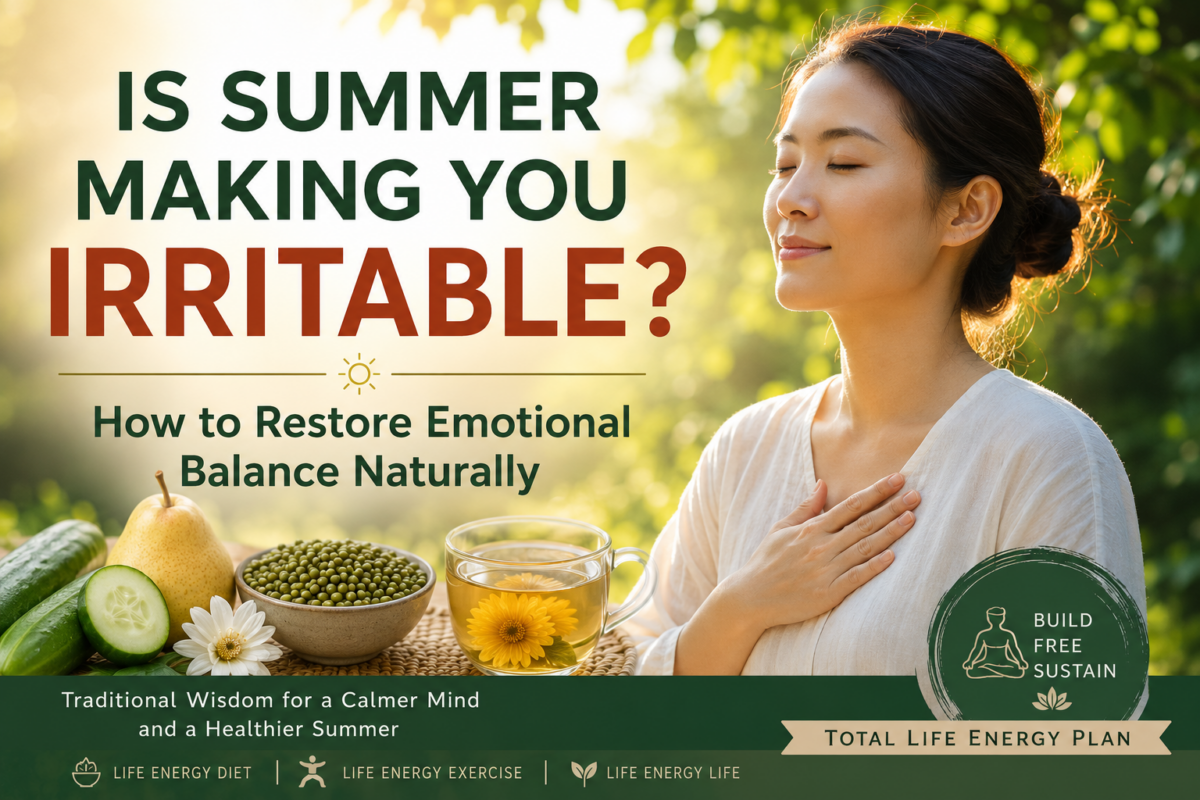
Is Summer Making You Irritable? How to Restore Emotional Balance Naturally

Summer is often associated with vacations, sunshine, and happiness. It seems like the perfect season to relax, recharge, and enjoy life.

Yet many people notice something unexpected.

They become more impatient.

Small frustrations feel bigger than they should.

Their minds become restless.

Sleep becomes lighter.

By early afternoon, they feel emotionally exhausted, even when the day has barely begun.

Most people blame work, stress, or lack of sleep. While these certainly play a role, they may not tell the whole story.

Traditional wisdom teaches that summer itself can influence our emotional well-being.

Just as spring, autumn, and winter each affect the body differently, summer places unique demands on both the body and the mind. Learning to work with the season rather than against it can help us remain calmer, clearer, and more emotionally balanced.

In this article, we’ll explore why emotional health is the first topic in the Summer Care Series and discover practical ways to keep both the Heart and Mind balanced during the warmest months of the year.


Welcome Back to the Summer Care Series

In our Introduction Week, we learned that health is life energy in abundance and that lasting health depends upon three interconnected pillars:

  • Life Energy Diet
  • Life Energy Exercise
  • Life Energy Life

This week we begin applying those principles to real summer health challenges.

The first challenge may surprise many people.

It isn’t heat exhaustion.

It isn’t dehydration.

It isn’t digestion.

It’s emotional health.

Our emotions are often the first signs that the body is struggling to maintain balance. Irritability, impatience, anxiety, restlessness, and mental fatigue may all be signals that the body is asking for support.

Instead of ignoring these signals or blaming ourselves, we can learn to understand what the body is trying to tell us.

The best evaluation is symptoms.

When we listen carefully, symptoms become valuable guides toward better health.


Why Does Summer Affect Our Emotions?

Nature becomes more active during summer.

Plants grow rapidly.

Animals become more energetic.

Days are longer.

Temperatures rise.

The human body also responds to these seasonal changes.

As summer heat increases, the body works continuously to maintain balance. Cooling itself requires energy. Adapting to longer daylight hours changes our daily rhythms. Even healthy outdoor activities increase the body’s workload.

When life energy is abundant, the body usually adapts well.

But when heat accumulates faster than the body can regulate it, emotional balance often begins to change.

Many people first notice this as:

  • Irritability
  • Impatience
  • Anxiety
  • Restlessness
  • Feeling mentally overwhelmed
  • Emotional exhaustion
  • Difficulty sleeping
  • Trouble relaxing

These symptoms are not simply personality traits.

They may be signs that the body is working harder than usual to cope with the season.


The Heart and Emotional Balance

Traditional Daoist health teachings associate summer with the Heart system.

The Heart is viewed as much more than a physical organ.

It is also considered the home of the Shen—our spirit, emotional awareness, and clarity of mind.

When the Heart is well balanced, people often feel peaceful, joyful, mentally clear, and emotionally steady.

When excessive summer heat accumulates, traditional teachings describe a condition often called Heart Fire.

Heart Fire does not refer to literal flames.

Rather, it describes a state in which excessive heat disturbs the natural balance of the Heart and Mind.

Common signs may include:

  • Irritability
  • Anxiety
  • Emotional agitation
  • Restlessness
  • Racing thoughts
  • Poor sleep
  • Difficulty concentrating
  • Feeling emotionally overwhelmed

The purpose of seasonal living is not to fear these symptoms but to recognize them early and gently restore balance before they become more serious.


One of Summer’s Biggest Mistakes

Many people ignore one of the body’s clearest warning signs.

Fatigue.

As the day becomes hotter, especially between 11:00 a.m. and 1:00 p.m., the body works harder to regulate itself.

Instead of slowing down, many people push even harder.

They skip breaks.

Continue working through exhaustion.

Ignore mental fatigue.

Fight through irritability.

Over time, this constant pushing may further drain life energy and make emotional balance increasingly difficult.

Traditional wisdom recommends working with the body’s natural rhythms instead of fighting them.

One remarkably simple practice is the Heart Nap.

Taking a short rest between 12:00 and 12:30 p.m., even if you do not fall asleep, gives both the body and mind an opportunity to recover while nature put the most pressure on the heart and the body.

Many people discover that just ten to twenty minutes of quiet rest leaves them calmer, clearer, and more productive throughout the afternoon.

Sometimes the healthiest choice is not doing more.

It is allowing the body time to restore itself.


A Simple Pressure Point for Emotional Balance

Another traditional practice is gentle acupressure.

One commonly used point is Heart 7, also known as Shenmen, or Spirit Gate.

Locate the crease on the inside of your wrist beneath the little finger.

Near the base of the palm, you’ll feel a small hollow.

Using your thumb, gently massage this area for about thirty seconds while breathing naturally.

Traditionally, this point has been used to help calm an overstimulated mind and support emotional balance.

Although simple, this practice serves as a helpful reminder to pause and reconnect with your body whenever emotional stress begins to build.


Food Can Calm—or Add Fuel to the Fire

Traditional health systems have long recognized that food influences more than hunger.

It also affects the body’s internal balance.

During hot summer weather, many people naturally benefit from reducing foods that generate excessive internal heat.

These include heavily spiced foods, greasy meals, and excessively rich foods.

Instead, summer invites us to enjoy foods that are naturally refreshing and appropriate for the season.

Some traditional favorites include:

  • Cucumbers
  • Pears
  • Mung beans
  • Chrysanthemum tea

These foods have been enjoyed for generations during summer because they are traditionally valued for helping the body adapt to seasonal heat while supporting a calmer state of mind.

As one of the guiding principles of the Total Life Energy Plan reminds us:

Food is the best medicine.

The best pharmacy is the kitchen.

At the same time, remember that grains remain the foundation of the daily diet throughout the year, while seasonal foods are chosen to complement them according to the season and your individual condition.


Restoring Balance Through Movement

When people feel emotionally overwhelmed, their first instinct is often to push themselves harder.

Traditional wisdom recommends a different approach.

Rather than simply burning more energy, summer is often a time to cultivate and preserve it.

Longevity Qigong is especially well suited for this purpose.

Its gentle movements help cultivate life energy, encourage its smooth circulation throughout the body, and store it in the Dantian. Instead of leaving you feeling depleted, regular practice helps restore emotional steadiness and supports a calmer, clearer state of mind.

For those seeking additional support, Steelman Qigong may be added to improve circulation throughout the body and promote overall harmony.

Together, these practices illustrate one of the central principles of the Total Life Energy Plan:

Build life energy.

Free its flow.

Sustain both.


Your Complete Summer Emotional Health Routine

Healthy emotions are not created by a single food, one exercise, or a quick technique.

They develop from many small daily choices working together.

When you begin feeling irritable, anxious, restless, or emotionally drained this summer, remember these five simple practices:

  1. Recognize emotional changes as signals that your body may be struggling with excessive summer heat.
  2. Whenever possible, take a Heart Nap between 12:00 and 12:30 p.m. to help restore balance during the hottest part of the day.
  3. Massage the Spirit Gate (Heart 7) point on your wrist for about thirty seconds whenever you feel mentally or emotionally overwhelmed.
  4. Continue making grains the foundation of your daily meals while supporting your body with simple seasonal foods such as cucumbers, pears, mung beans, and chrysanthemum tea.
  5. Practice Longevity Qigong regularly to cultivate and store life energy, and add Steelman Qigong to improve circulation and support overall harmony.

None of these practices is complicated.

Yet together they create a practical, natural approach to maintaining emotional balance throughout the summer.


Featured Wisdom

“Calmness cannot be forced. It grows naturally when life energy is abundant, flowing freely, and living in harmony with the season.”


Practical Self-Healing Plan

What to Start

  • Notice how your emotions change as summer temperatures rise.
  • Take a short Heart Nap around midday whenever your schedule allows.
  • Build moments of quiet reflection into your day instead of waiting until you feel overwhelmed.

What to Reduce

  • Working through exhaustion during the hottest hours of the day.
  • Excessively spicy, greasy, and heavy foods during hot weather.
  • Constant mental stimulation without time for rest.

Foods to Favor

  • Make grains the foundation of your daily meals.
  • Include seasonal summer foods such as cucumbers, pears, mung beans, and chrysanthemum tea to help the body adapt to the season.
  • Choose simply prepared meals that are appropriate for both the season and your individual condition.

Daily Habits

  • Follow a consistent daily routine.
  • Balance work with periods of rest.
  • Spend time outdoors during the cooler parts of the day.
  • Listen to your body’s signals instead of pushing through fatigue.

Exercise Recommendation

Practice Longevity Qigong regularly to cultivate and store life energy. If appropriate, add Steelman Qigong to improve circulation and support overall harmony throughout the body.

Rest Recommendation

Treat rest as part of your daily health routine, not as a reward after exhaustion. A brief period of quiet during the middle of the day can help restore emotional balance and preserve life energy throughout the summer.


Key Takeaways

  • Emotional changes are often among the earliest signs that the body is struggling with summer heat.
  • Traditional Daoist wisdom associates summer with the Heart, which influences emotional balance and mental clarity.
  • Ignoring midday fatigue may increase emotional stress and gradually drain life energy.
  • A Heart Nap, gentle acupressure at Heart 7 (Spirit Gate), appropriate seasonal foods, and Longevity Qigong work together to support emotional well-being.
  • Lasting emotional balance comes from building life energy, freeing its flow, and sustaining both through healthy daily choices that work in harmony with the season.

Frequently Asked Questions

Why do I feel more irritable during the summer?

Summer naturally places greater demands on the body. As temperatures rise, the body works harder to maintain balance. Traditional Daoist health teachings recognize that excessive summer heat can disturb the Heart and Mind, making it easier to become impatient, emotionally drained, restless, or overwhelmed. Rather than viewing irritability as simply a personality issue, it can be helpful to recognize it as one of the body’s early signals that it needs support.


Can hot weather really affect my emotions?

Yes. Most people notice changes in their mood or patience during periods of prolonged heat. Traditional wisdom teaches that summer influences not only the body but also the emotions. When the body’s balance is disturbed by excessive heat, emotional steadiness may become more difficult to maintain. Supporting the body through seasonal living can help restore greater calm and clarity.


What is Heart Fire?

In Daoist and traditional Chinese health teachings, Heart Fire describes a pattern of excessive heat disturbing the Heart system. It does not refer to a disease or literal fire. Instead, it describes a state in which excessive heat may contribute to irritability, anxiety, restlessness, poor sleep, racing thoughts, or emotional agitation. The goal is not to fear Heart Fire but to recognize its early signs and gently restore balance through appropriate food, rest, exercise, and daily habits.


Why is a Heart Nap recommended during the summer?

Traditional seasonal living recognizes that the period between 11:00 a.m. and 1:00 p.m. places greater demands on the Heart during summer. A short Heart Nap, or simply resting quietly between 12:00 and 12:30 p.m., allows the body and mind to recover during the hottest part of the day. Even a brief period of rest may help preserve life energy and support emotional balance throughout the afternoon.


What is the Spirit Gate (Heart 7) point?

Heart 7, traditionally known as Shenmen or Spirit Gate, is a commonly used acupressure point located on the inside of the wrist beneath the little finger. It has traditionally been used to help calm an overstimulated mind and support emotional balance. Gently massaging this point for about thirty seconds can also serve as a reminder to pause and reconnect with your body during stressful moments.


What foods help support emotional balance during summer?

Traditional summer foods often include cucumbers, pears, mung beans, and chrysanthemum tea. These foods have long been valued for helping the body adapt to seasonal heat. At the same time, the Total Life Energy Plan teaches that grains remain the foundation of the daily diet throughout the year, while seasonal vegetables, fruits, beans, herbs, and other foods are chosen to complement them according to the season and the individual’s condition.


Why is Longevity Qigong recommended during the summer?

Summer is not always the season to burn more energy. Sometimes the body benefits more from restoring and preserving it. Longevity Qigong helps cultivate life energy, promote its smooth circulation, and store it in the Dantian. Regular practice supports emotional steadiness while helping reduce the feeling of being constantly drained. Steelman Qigong may also be practiced to improve circulation and support overall harmony throughout the body.


Traditional Wisdom Behind This Topic

The ideas shared in this article are rooted in traditional principles that have guided healthy seasonal living for generations. Although different traditions use different language, they share a common understanding: emotional well-being is closely connected to the body’s relationship with nature.

The Heart and the Shen

Traditional Daoist health teachings describe the Heart as more than a physical organ. The Heart is also the home of the Shen, often translated as the spirit, emotional awareness, or conscious mind.

When the Heart is well balanced, the Shen is calm and clear. Joy arises naturally, thinking becomes clearer, and emotional responses are more balanced.

When excessive heat disturbs the Heart, the Shen may become unsettled, leading to irritability, anxiety, restlessness, poor sleep, or emotional exhaustion.

From this perspective, emotional health is not simply a matter of willpower. It reflects the overall harmony of the body.


Summer and the Fire Element

Traditional seasonal wisdom associates summer with the Fire Element, representing warmth, growth, activity, and outward expression.

Fire brings light and vitality, but like any element, balance is essential. Too little fire may leave us feeling uninspired, while excessive fire may create agitation, restlessness, and emotional instability.

Seasonal living teaches us to support the positive qualities of summer while avoiding the excesses that can gradually disturb emotional balance.


Prevention Is Better Than Correction

One of the central principles of traditional health is that prevention is always easier than recovery.

Rather than waiting until emotional exhaustion becomes overwhelming, seasonal living encourages us to make small daily adjustments that help maintain balance before more serious problems develop.

A short midday rest.

Simple seasonal foods.

Gentle movement.

Time spent in nature.

Regular daily routines.

These habits may seem ordinary, but practiced consistently, they help preserve life energy and support lasting emotional well-being.


Continue Your Summer Care Journey

Emotional balance is one of the first signs of a healthy body, but it is only the beginning of your summer wellness journey.

Throughout the Summer Care Series, you’ll continue learning practical ways to support your health through the three pillars of the Total Life Energy Plan:

  • Life Energy Diet to nourish life energy through appropriate seasonal foods.
  • Life Energy Exercise to build life energy and keep it flowing freely.
  • Life Energy Life to cultivate healthy daily habits, emotional balance, and seasonal living.

Together, these three pillars help us build life energy, free its flow, and sustain both throughout every season.

In our next article, we’ll explore another challenge many people experience during hot weather:

Sleep Problems.

You’ll discover why warm summer nights can make restful sleep more difficult and learn practical ways to support deeper, more refreshing sleep through seasonal living, appropriate food choices, healthy daily habits, and traditional self-healing practices.

One healthy habit builds upon another. By making small adjustments each week, you’ll create a strong foundation for lasting health throughout the summer and beyond.


Traditional Wisdom Disclaimer

The ideas presented in this article are based on traditional Chinese and Daoist health principles and are intended for educational purposes only. They are designed to help readers better understand seasonal living and support the body’s natural capacity for health. They are not intended to diagnose, treat, cure, or prevent disease. Individual needs vary, and readers should consult a qualified healthcare professional regarding medical concerns.


Your energy matters.

Your healing matters.

Unleash your self-healing power with the Total Life Energy Plan.

Lasting health, powered by nature and honored by history.

Health is life energy in abundance.

Why Summer Makes So Many People Feel Worse:

Summer is supposed to be the season of energy and vitality. So why do so many people experience fatigue, poor sleep, emotional stress, digestive discomfort, and excessive sweating? Discover a different way to think about summer health through seasonal living and life energy.

A Different Way to Think About Summer Health

☀️ NEW TO THE SUMMER CARE SERIES?

Welcome.

This article is the official starting point for the entire Summer Care Series.

Over the coming months, we’ll explore why so many people struggle with fatigue, poor sleep, emotional stress, excessive sweating, digestive discomfort, joint pain, and other health challenges during summer.

You’ll also learn the core principles behind the Total Life Energy Plan, including:

✓ Life Energy Diet
✓ Life Energy Exercise
✓ Life Energy Life

✓ Build Life Energy
✓ Free Its Flow
✓ Sustain Both

After reading this article, continue your journey by visiting the Summer Care Hub:

TotalLifeEnergyPlan.com/summer-care

Health Transformation Starts Here.

Continue reading “Why Summer Makes So Many People Feel Worse:”